Pool Ball Colors and Numbers: Complete Chart (1–15)
Share
Every standard pool set uses the same colors and numbers — and once you know the pattern, you'll never have to hunt for a ball again. Whether you're new to the game or just curious why the 1 and the 9 are both yellow, this guide lays out the full color-and-number system, the logic behind it, and how snooker and novelty sets differ.
Quick answer: A standard American pool set has 16 balls: seven solids (numbered 1–7), seven stripes (numbered 9–15), the solid black 8-ball, and the white cue ball. Each stripe shares its color with the solid seven numbers lower — the 1 and 9 are yellow, the 2 and 10 are blue, and so on. The colors are: 1/9 yellow, 2/10 blue, 3/11 red, 4/12 purple, 5/13 orange, 6/14 green, 7/15 maroon, and 8 black.
Pool ball color and number chart
| Number | Color | Type |
|---|---|---|
| 1 | Yellow | Solid |
| 2 | Blue | Solid |
| 3 | Red | Solid |
| 4 | Purple | Solid |
| 5 | Orange | Solid |
| 6 | Green | Solid |
| 7 | Maroon (burgundy) | Solid |
| 8 | Black | Solid (its own class) |
| 9 | Yellow | Stripe |
| 10 | Blue | Stripe |
| 11 | Red | Stripe |
| 12 | Purple | Stripe |
| 13 | Orange | Stripe |
| 14 | Green | Stripe |
| 15 | Maroon (burgundy) | Stripe |
| Cue ball | White | — |
Need a set with these exact colors?
Every set we sell follows the standard 1–15 numbering above. Browse pool ball sets — regulation, novelty and pro-grade — or pick by brand: Aramith, Aska. Playing snooker? See snooker balls.
Solids vs stripes
The fifteen numbered balls split into two groups. Solids (also called "lows") are balls 1–7: each is one uniform color with a small white circle carrying the number. Stripes (or "highs") are balls 9–15: mostly white with a colored band around the middle and the number printed on the stripe. The 8-ball is solid black and sits in a category of its own — in eight-ball it's the last ball you pot to win.
Why the 1 and 9 are both yellow
The color pairing isn't random: every stripe uses the same color as the solid exactly eight numbers lower. Add 8 to any solid to find its striped twin — 1→9 (yellow), 2→10 (blue), 3→11 (red), 4→12 (purple), 5→13 (orange), 6→14 (green), 7→15 (maroon). That single rule lets you identify any ball's color the moment you know its number.
The logic behind the colors
The palette follows color theory so the balls are easy to tell apart on the table:
- Primary colors — yellow (1/9), blue (2/10), red (3/11). These sit far apart on the color wheel for maximum contrast.
- Secondary colors — purple (4/12), orange (5/13), green (6/14).
- Tertiary color — maroon (7/15), the only ball that's neither primary nor secondary.
Distinct, high-contrast colors let your eye locate a ball at a glance instead of reading fifteen numbers one by one — which matters under the warm, low lighting of many pool rooms. The number is the primary identifier; the color is the fast visual shortcut.
The 8-ball and the cue ball
The 8-ball is always solid black with a white number circle, keeping it instantly distinct from both groups — fitting, since it's the game-deciding ball in eight-ball. The cue ball (the white ball you strike) usually has no number, though training cue balls may carry spots or targets to help you learn spin.
How snooker and novelty sets differ
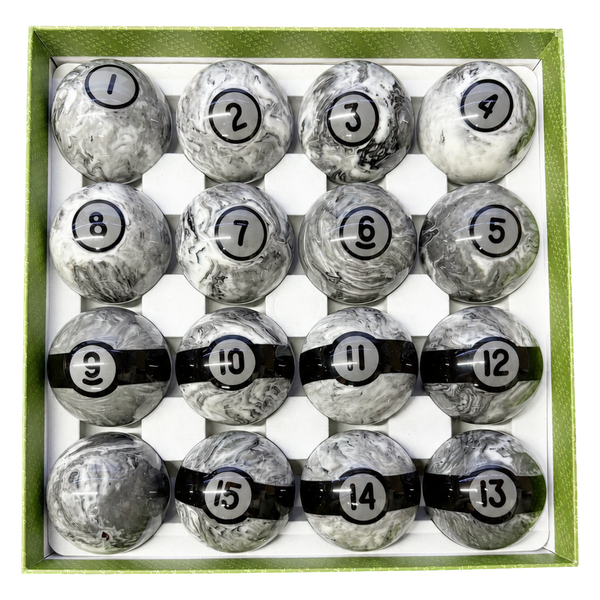
Not every set follows the numbered American scheme. Snooker balls use no numbers at all: 15 reds plus six "colours" (yellow, green, brown, blue, pink, black), each worth a different point value, and they're typically a smaller 2 1/16" size. Meanwhile, novelty pool sets — such as poker-themed, pastel, marbled or tournament designs — keep the exact same 1–15 numbering and solids/stripes structure, just with different aesthetics, so they play identically to a standard set. If you like a distinctive look, you can browse pool ball sets in a range of styles without changing how the game works.
Frequently asked questions
What are the colors of pool balls by number?
1 and 9 are yellow, 2 and 10 blue, 3 and 11 red, 4 and 12 purple, 5 and 13 orange, 6 and 14 green, 7 and 15 maroon, and the 8 is black. The cue ball is white.
How many balls are in a pool set?
Sixteen: seven solids (1–7), seven stripes (9–15), the black 8-ball, and the white cue ball. Together the fifteen numbered balls make up a full rack.
Which pool balls are solids and which are stripes?
Balls 1 through 7 are solids ("lows"); balls 9 through 15 are stripes ("highs"). The 8-ball is black and belongs to neither group.
Why do two pool balls share each color?
Because every stripe matches the solid eight numbers below it (1 and 9, 2 and 10, and so on). It's a deliberate pattern that makes each ball's color predictable from its number.
Are novelty or colored pool balls regulation?
Most novelty sets (poker, pastel, marbled) use the standard 1–15 numbering and sizing, so they play the same as a regular set. For sanctioned tournament play, though, you'll want a regulation set that meets official specifications.
Ready for a fresh set? Browse the full Aska Billiards pool ball collection, from classic numbered sets to novelty styles, or explore snooker balls. Not sure which size fits your table? See our pool ball size chart.